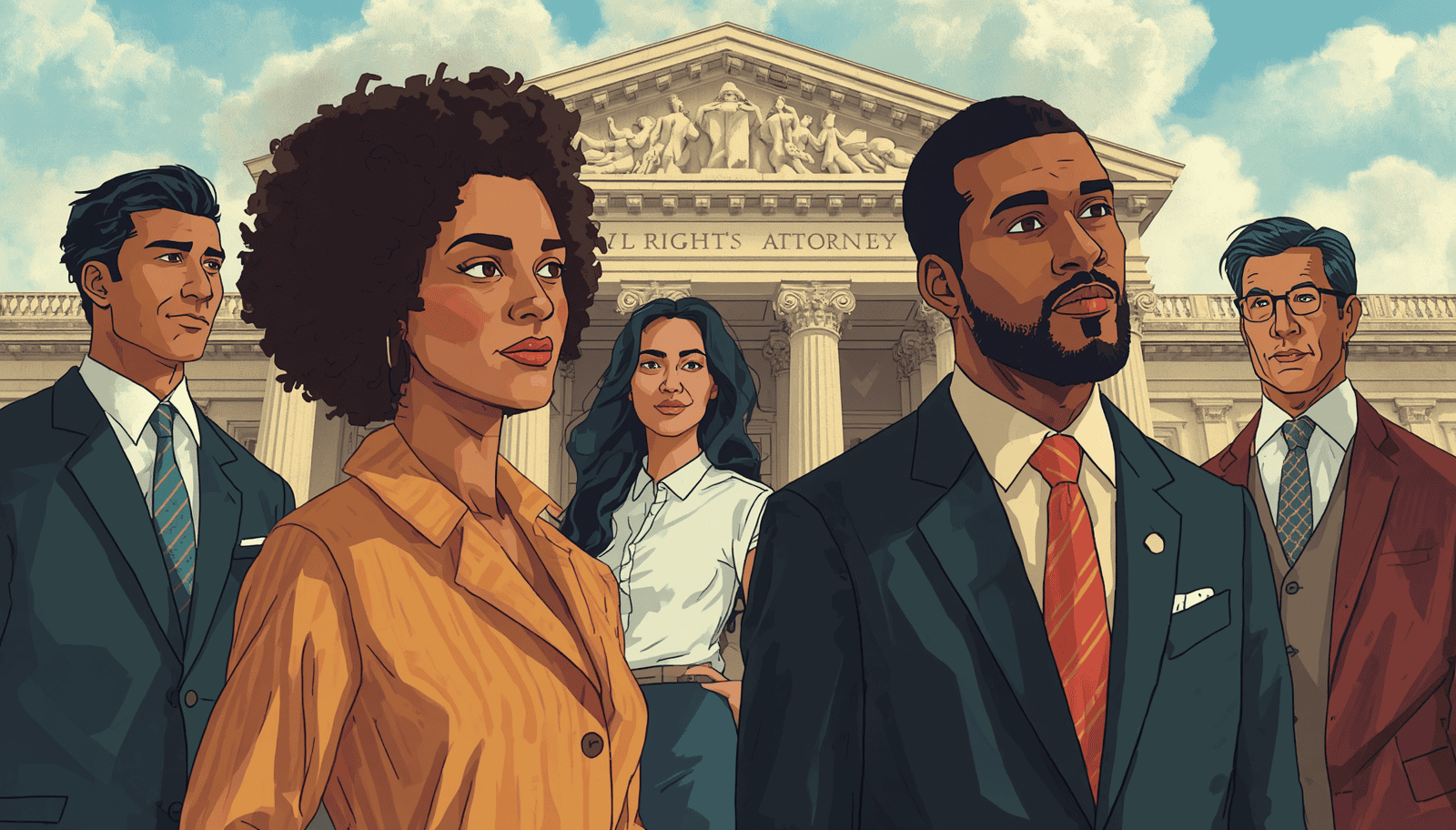
A search for a free civil rights attorney can mean several different things. You may be looking for a lawyer who charges nothing, a nonprofit legal-aid office, a pro bono attorney, a free consultation, a lawyer who gets paid only if the case succeeds, or help filing a complaint with a government agency.
The right path depends on what happened, where it happened, who violated your rights, how long ago it happened, and what kind of help you need. Civil rights matters can involve short agency deadlines, local court rules, government-immunity issues, and different procedures for employment, housing, education, police misconduct, jail abuse, disability discrimination, voting rights, and other claims.
Can You Get a Free Civil Rights Attorney?
Sometimes, yes. But in most civil rights cases, there is no automatic right to have the court appoint a free lawyer for you. The American Bar Association explains that in non-criminal civil cases, people generally do not have a right to a free lawyer, even though legal-aid and pro bono programs may provide free help in some civil matters.
The U.S. Department of Justice’s Access to Justice materials also explain that the right to a lawyer is generally limited to criminal cases, while civil legal aid helps with non-criminal problems involving basic needs such as housing, employment, education, benefits, and health care.
That does not mean help is unavailable. “Free civil rights attorney” may refer to several different kinds of help:
- Legal aid may provide free legal advice or representation if you meet income, location, and case-type requirements.
- Pro bono lawyers may volunteer their time for selected cases.
- A free consultation may help you understand whether you have a case, but it usually does not mean the lawyer will represent you for free.
- A contingency-fee lawyer may charge no upfront attorney’s fee and instead take a percentage if the case recovers money.
- In some civil rights cases, fee-shifting laws may allow a successful plaintiff to seek attorney’s fees from the defendant, depending on the claim and the court’s ruling.
There is also government-agency help. Agencies such as the Equal Employment Opportunity Commission, the Department of Housing and Urban Development, the Department of Education Office for Civil Rights, and the Department of Justice Civil Rights Division may accept complaints or reports. Those agencies enforce civil rights laws, but they are not the same as having your own private attorney.
Free help is limited. The Legal Services Corporation’s 2022 Justice Gap Study found that 92% of the civil legal problems reported by low-income Americans did not receive any or enough legal help. That statistic is about civil legal problems generally, not civil rights cases specifically, but it helps explain why legal-aid offices and pro bono programs often must turn away eligible people.
The Difference Between Free Legal Aid, Pro Bono, and Free Consultations
Legal aid usually means free legal help from a nonprofit organization that serves people who meet income and case-priority rules. These offices often focus on urgent civil legal needs such as housing, safety, benefits, employment, education, disability access, and family stability. Legal-aid eligibility is not based only on income; it can also depend on household size, assets, immigration status for some services, county, funding restrictions, and whether the office handles your type of problem.
Many legal-aid programs use income guidelines tied to the federal poverty guidelines or a percentage of those guidelines. The 2026 HHS poverty-guideline notice explains that some programs use percentage multiples such as 125% or 185%, but the notice itself does not decide legal-aid eligibility. Local programs set their own rules within the limits of their funding.
Pro bono means a lawyer provides legal services for free or at a reduced cost as a public service. A pro bono attorney may work through a bar association, law firm, nonprofit, law school clinic, religious organization, or civil rights group. Pro bono help is often limited to cases that fit the program’s mission, resources, and available volunteer attorneys.
A free consultation is different. A private civil rights attorney may offer a free first meeting to evaluate your case. That meeting can be valuable, especially if you need to identify deadlines or preserve evidence. But a free consultation does not automatically mean the lawyer will take the case, file an agency complaint, or represent you without charge.
A contingency fee means the lawyer is paid from the recovery if the case succeeds. This arrangement is common in some damages cases, but not all civil rights lawyers use it, and not all civil rights claims are good fits for contingency representation.
Fee-shifting means a law may allow a successful plaintiff to ask the court to order the defendant to pay reasonable attorney’s fees. The Civil Rights Attorney’s Fees Awards Act, codified in part at 42 U.S.C. § 1988, is one example for certain federal civil rights actions. Fee-shifting can make some civil rights cases more realistic to bring, but it is not a guarantee of free representation. The lawyer will still evaluate the strength of the claim, the available evidence, the risk of losing, and whether the law actually allows fees for that type of case.

Civil Rights Issues That May Qualify for Free or No-Upfront Legal Help
Civil rights cases can arise in many settings. Some may be handled by legal aid. Some may be better suited for a private attorney who handles lawsuits. Others may start with an agency complaint. The correct path depends heavily on the issue.
Common civil rights issues include police misconduct, excessive force, false arrest, wrongful detention, jail or prison abuse, denial of medical care in custody, discrimination at work, harassment, retaliation, housing discrimination, disability-access problems, school discrimination, special-education-related discrimination, voting-rights barriers, discrimination in public accommodations, and abuse of power by government officials.
The type of case affects the deadline, forum, and lawyer you need. An employment discrimination claim may need an EEOC charge before a lawsuit. A housing discrimination claim may go through HUD, a state or local fair-housing agency, or court. An education discrimination complaint may go to the Department of Education Office for Civil Rights. A police misconduct or jail-abuse case may require a civil rights litigation attorney familiar with government defendants, evidence preservation, medical records, and local court rules.
Claims against government defendants can raise extra barriers, including immunity defenses, notice rules for some state-law claims, shorter practical evidence-preservation windows, and local procedures. In jail or prison cases, the Prison Litigation Reform Act, 42 U.S.C. § 1997e(a), generally requires incarcerated people to exhaust available administrative remedies before filing a federal lawsuit about prison conditions.
Because deadlines can be short, do not wait until you find the perfect free attorney before checking the filing deadline for your type of claim.
Where to Look First for Free Civil Rights Legal Help
Legal Services Corporation and local legal aid offices
The Legal Services Corporation funds independent nonprofit legal-aid organizations that help eligible low-income people with civil legal problems. LSC says its grantees serve every state, the District of Columbia, and U.S. territories, and its “I Need Legal Help” page lets users search by address or city for an LSC-funded office nearby.
A local legal-aid office is often the best first stop if your civil rights problem involves housing, employment, public benefits, disability access, school access, domestic violence-related rights, consumer issues connected to discrimination, or another basic civil legal need. Legal-aid offices may not handle every civil rights lawsuit, but intake staff can often tell you whether they can help, whether another group is a better fit, or whether an agency deadline is approaching.
LawHelp and statewide legal-aid portals
LawHelp and statewide legal-aid websites can provide legal information, court forms, self-help tools, and referrals to nonprofit legal-aid organizations. USA lists LawHelp.org as a place to find free legal aid and answers to legal questions for people with low to moderate incomes.
Availability can vary by state and by website status. If the national LawHelp site is unavailable or under maintenance, search for your state’s legal-aid portal, your state bar association’s legal-help page, or your county’s court self-help center.
ABA Free Legal Answers
ABA Free Legal Answers is a virtual legal advice clinic. Qualifying users can post civil legal questions at no cost, and pro bono attorneys licensed in their state may answer. The program lists civil rights among the question topics it covers, along with housing, employment, health and disability, education, and other civil matters.
This service can be useful if you need initial guidance, help understanding a notice, or direction on next steps. It is not the same as full representation in court, and it does not handle criminal-law questions.
Law school clinics and local bar pro bono programs
Law school clinics and local bar association pro bono programs may help with selected civil rights issues. USA lists law school pro bono programs and ABA Free Legal Answers among resources for affordable or free legal help.
Clinics often focus on specific subjects, such as housing, employment, disability rights, constitutional litigation, prisoners’ rights, education law, immigration, veterans’ rights, or public benefits. They may operate on academic calendars and may have limited intake periods. Bar pro bono programs also vary widely. Some provide brief advice clinics, while others place selected cases with volunteer attorneys.
Civil rights nonprofits and public-interest firms
Civil rights nonprofits and public-interest law firms may accept selected cases that fit their mission. These organizations often focus on systemic discrimination, government abuse, impact litigation, voting rights, disability rights, racial justice, LGBTQ+ rights, immigrants’ rights, prisoners’ rights, or free-speech issues.
Many civil rights nonprofits do not operate like general legal-aid intake offices. They may take only a small number of cases, prioritize cases that could change policy, or focus on a specific population or issue. A rejection from one nonprofit does not necessarily mean your claim lacks merit; it may simply mean the case does not fit that organization’s priorities or capacity.
When a Civil Rights Lawyer May Take Your Case With No Upfront Fee
A private civil rights lawyer may consider taking a case with no upfront attorney’s fee when the case has strong evidence, serious harm, a legally responsible defendant, available damages or other meaningful relief, and unexpired deadlines. The lawyer will also consider whether the claim is legally viable in the correct jurisdiction and whether any immunity, notice, exhaustion, or procedural rules create barriers.
Contingency-fee representation is more likely when the case involves recoverable damages. For example, a lawyer may be more willing to consider a no-upfront-fee arrangement when the client suffered a job loss, serious emotional distress supported by evidence, physical injury, medical bills, lost housing, denial of access, detention, or another measurable harm. Even then, fee arrangements vary by lawyer and case type.
Fee-shifting can also matter. Under 42 U.S.C. § 1988, courts may award reasonable attorney’s fees to a prevailing party in certain federal civil rights actions. Other civil rights laws may have their own fee provisions. Fee-shifting can make a case possible when the client cannot pay hourly fees, but it depends on the specific law, the outcome, and the court. It should not be treated as automatic.
A lawyer may be less likely to take a case on contingency if the main goal is an apology, policy change, records correction, accommodation, reinstatement, or injunctive relief without significant damages. Those goals may still be important and legally valid, but they can be harder to fund through a contingency-fee model.

When to File a Government Complaint Before or Alongside Finding a Lawyer
Some civil rights claims have administrative complaint deadlines that can expire before you find a free attorney. Filing with an agency may preserve certain rights, start an investigation, or be required before a lawsuit. But filing with the wrong agency, missing a deadline, or leaving out key facts can create problems, so it is wise to seek legal advice as early as possible.
Employment discrimination complaints
For most private-sector, state-government, and local-government employment discrimination claims under laws enforced by the EEOC, a charge generally must be filed within 180 calendar days of the discrimination. The EEOC says the deadline may extend to 300 calendar days if a state or local agency enforces a law prohibiting employment discrimination on the same basis. The EEOC also notes that age-discrimination deadline rules have some differences.
Federal employees and federal job applicants have a different process. The EEOC states that they generally must contact an agency EEO Counselor within 45 days from the day the discrimination occurred.
Employment deadlines depend on the claim, employer type, state or local agency coverage, and whether you are a federal employee. If the issue involves termination, harassment, failure to hire, denial of accommodation, retaliation, unequal pay, discipline, or a hostile work environment, check the EEOC deadline immediately while you continue looking for a lawyer. For many EEOC-enforced employment discrimination claims, the administrative charge is not just optional; it may be required before a lawsuit.
Housing discrimination complaints
For Fair Housing Act complaints through HUD’s Fair Housing and Equal Opportunity process, HUD states that an allegation must be filed within one year of the last date of the alleged discrimination. HUD also states that a private civil lawsuit generally must be filed within two years of the most recent alleged discriminatory action, and that time during HUD’s processing may not count against that two-year filing period.
Housing discrimination can involve refusal to rent or sell, discriminatory terms, steering, harassment, disability-accommodation denials, family-status discrimination, lending discrimination, zoning issues, or retaliation. State and local fair-housing agencies may have their own procedures, so check both federal and local options.
Education discrimination complaints
The Department of Education Office for Civil Rights generally requires complaints to be filed within 180 calendar days of the alleged discrimination. OCR may consider a waiver request if the complaint is late, but the complainant must explain the delay and OCR decides whether to grant the waiver. OCR also screens complaints to decide whether it has authority, whether the complaint states a covered violation, whether enough detail is provided, and whether another process or lawsuit affects the complaint.
Education civil rights issues may involve race, color, national origin, sex, disability, or age discrimination in schools or educational programs that receive federal funds. Examples can include discriminatory discipline, disability-access barriers, denial of language access, sexual harassment, failure to respond to harassment, or unequal access to programs.
DOJ civil rights complaints
The Department of Justice Civil Rights Division accepts reports from people who believe they or someone else experienced a civil rights violation. Its online reporting form asks for contact information, the primary concern, location, personal characteristics, date, and a description of what happened. DOJ states that the purpose of the form is to allow the public to submit civil rights complaints so the department can enforce civil rights statutes within its authority.
A DOJ report is not the same as hiring a personal lawyer. The DOJ may review reports for enforcement purposes, but it does not become every complainant’s private attorney. If you need someone to represent you personally, seek legal aid, pro bono help, or a private civil rights attorney while also watching any agency or court deadlines.
What to Prepare Before Contacting a Free or Pro Bono Civil Rights Attorney
Before you contact a free civil rights attorney, legal-aid office, or pro bono program, organize the facts so the intake person can quickly understand the problem. You do not need a perfect legal theory. You need a clear timeline and the most important proof.
Prepare the following if you have it:
- A timeline of what happened, with dates as exact as possible
- Names, job titles, badge numbers, agencies, employers, landlords, schools, witnesses, and decision-makers
- Photos, videos, screenshots, text messages, emails, voicemails, letters, notices, and social-media messages
- Police reports, incident reports, grievance forms, disciplinary records, write-ups, termination letters, school notices, housing notices, or accommodation requests
- Medical records, therapy records, jail or prison medical requests, injury photos, or discharge papers if physical or emotional harm is part of the claim
- Employment documents such as schedules, pay records, job descriptions, performance reviews, HR complaints, and leave or accommodation paperwork
- Housing documents such as lease agreements, rent ledgers, applications, denial letters, inspection reports, repair requests, and eviction notices
- School documents such as individualized education programs, Section 504 plans, discipline notices, emails with administrators, and complaint records
- Any agency letters, charge numbers, complaint confirmations, right-to-sue notices, appeal notices, or court papers
- A list of deadlines you know about, including when the discrimination happened and when you received any notice
Preserve originals whenever possible. Make copies for lawyers or agencies. Do not edit screenshots, delete messages, alter photos, or post sensitive evidence publicly. If video or digital evidence is in someone else’s control, write down who has it, when it was created, and why it matters.
Why Free Civil Rights Lawyers May Decline a Case
A legal-aid office, pro bono program, or civil rights nonprofit may decline a case for reasons that have nothing to do with whether you were mistreated. Free legal services have limited staff, limited funding, and case priorities. Even eligible people may be turned away because the office lacks capacity or does not handle that type of case.
Common reasons include income or asset ineligibility, a case outside the program’s geographic area, a conflict of interest, an expired deadline, weak evidence, missing defendants, no practical remedy, limited damages, a defendant who is immune from certain claims, or an issue outside the organization’s mission. Some organizations also decline cases that require urgent court filings they cannot staff, cases already too far along, or cases that need a specialist they do not have.
If one program says no, ask whether it can provide referrals. Also ask whether there is an agency deadline, court deadline, appeal deadline, or preservation step you should know about.
What to Do If You Cannot Find a Free Civil Rights Attorney
If you cannot find a free civil rights attorney, keep moving. Do not let the search itself cause you to miss a deadline.
Contact more than one resource. Try your local legal-aid office, statewide legal-aid portal, state bar lawyer-referral service, local bar pro bono program, law school clinic, court self-help center, and issue-specific nonprofit. USA lists several national starting points, including LSC, LawHelp, law school pro bono programs, Law Help Interactive, and ABA Free Legal Answers.
Consider limited-scope representation. Some lawyers may not take the whole case but may agree to review an agency complaint, help draft a demand letter, advise you before mediation, explain a right-to-sue notice, prepare you for a hearing, or coach you on evidence.
Use agency complaint processes when appropriate. For employment, housing, and education discrimination, an agency filing may be an important step even while you continue looking for counsel. Make sure you understand whether filing with one agency affects another deadline.
Use court self-help resources carefully. Self-help centers cannot act as your lawyer, but they may provide forms, procedural information, filing instructions, fee-waiver information, and referrals. The DOJ’s Access to Justice materials recognize court-based services, self-help centers, online legal information, and document tools as part of the broader civil legal-aid ecosystem.
Keep preserving evidence. Save documents, write down dates, identify witnesses, request copies of records, and keep all agency and court notices. If you later find a lawyer, organized evidence can make the difference between a quick rejection and a serious review.

Questions to Ask Before Hiring or Accepting Help From a Civil Rights Lawyer
Before you hire a civil rights attorney or accept free or pro bono help, make sure you understand the relationship. A lawyer may offer brief advice, limited-scope help, agency representation, settlement negotiation, or full litigation. Those are not the same.
Ask what fees apply. If the lawyer says there is no upfront fee, ask whether the case is contingency-based, pro bono, legal-aid funded, reduced-fee, or potentially fee-shifting. Ask who pays litigation costs such as filing fees, service fees, deposition transcripts, expert witnesses, medical records, travel, copying, and appeal costs.
Ask what the lawyer will handle. Will the lawyer file an EEOC, HUD, OCR, state-agency, or local-agency complaint? Will the lawyer represent you in mediation, court, settlement talks, administrative hearings, appeals, or only the initial review?
Ask about deadlines. Which agency deadlines, court deadlines, notice requirements, grievance deadlines, appeal deadlines, or preservation letters apply? Are any deadlines close?
Ask who will work on the case. Will your main contact be the attorney, a paralegal, a clinic student, a supervising lawyer, or a volunteer? How often should you expect updates?
Ask about settlement authority. Who decides whether to accept a settlement? What happens if you want to settle and the lawyer disagrees, or if the lawyer recommends settlement and you want to continue?
Ask what happens if the case loses. Will you owe costs? Could the other side seek costs or fees? Would the lawyer handle an appeal? Are there risks of retaliation, public records, confidentiality limits, immigration consequences, employment consequences, or other practical concerns?
A good attorney-client relationship should be clear from the start. Whether you are looking for a free civil rights attorney, pro bono help, contingency-based representation, or paid counsel, you should understand the scope of representation, the fee arrangement, the deadlines, and the next step before you rely on anyone to protect your civil rights.
Frequently Asked Questions
Can I get a free civil rights attorney for my case?
Sometimes. Free help may come from legal aid, a pro bono attorney, a civil rights nonprofit, a law school clinic, or a lawyer who takes the case with no upfront fee. There is usually no automatic right to a free lawyer in a civil rights case, so availability depends on your income, location, case type, evidence, deadlines, and the program or lawyer’s capacity.
Is a free consultation the same as free legal representation?
No. A free consultation is usually an initial meeting or case review. It may help you understand deadlines, evidence, and possible next steps, but it does not mean the lawyer will file a complaint, go to court, or represent you for free.
What types of civil rights problems may qualify for free or no-upfront-fee legal help?
Possible issues include employment discrimination, housing discrimination, disability-access problems, school discrimination, police misconduct, jail or prison abuse, voting-rights barriers, retaliation, and discrimination in public accommodations. The right place to seek help depends on the issue, the deadline, the evidence, and whether the matter should start with a lawyer, legal-aid office, nonprofit, or government agency.
Should I file a government complaint while looking for a lawyer?
For some civil rights claims, yes. Employment, housing, and education discrimination complaints may have agency deadlines that can expire before you find a lawyer. Filing with the wrong agency or leaving out important facts can create problems, so it is best to seek legal advice early while also checking the deadline for your type of claim.
What should I prepare before contacting a free civil rights attorney or legal-aid office?
Prepare a clear timeline, names of people involved, documents, photos, videos, messages, notices, reports, medical records, employment records, housing records, school records, agency letters, court papers, and any deadlines you know about. Keep originals safe, make copies when needed, and do not edit, delete, or publicly post sensitive evidence.